Minneapolis Water Hardness, Read From the City's Plant Records
Minneapolis water hardness is not a guess or a ZIP-code estimate. The city publishes a yearly record and a monthly analysis of the water leaving its plants, and both say the same thing: moderately hard, and steady.
The city's 2025 plant record lists total hardness at 80 to 113 mg/L, averaging 94, or about 4.7 to 6.6 grains per gallon. The September 2026 analysis read 5.1 grains. The U.S. Geological Survey calls 61 to 120 mg/L moderately hard.
Where does Minneapolis water come from?
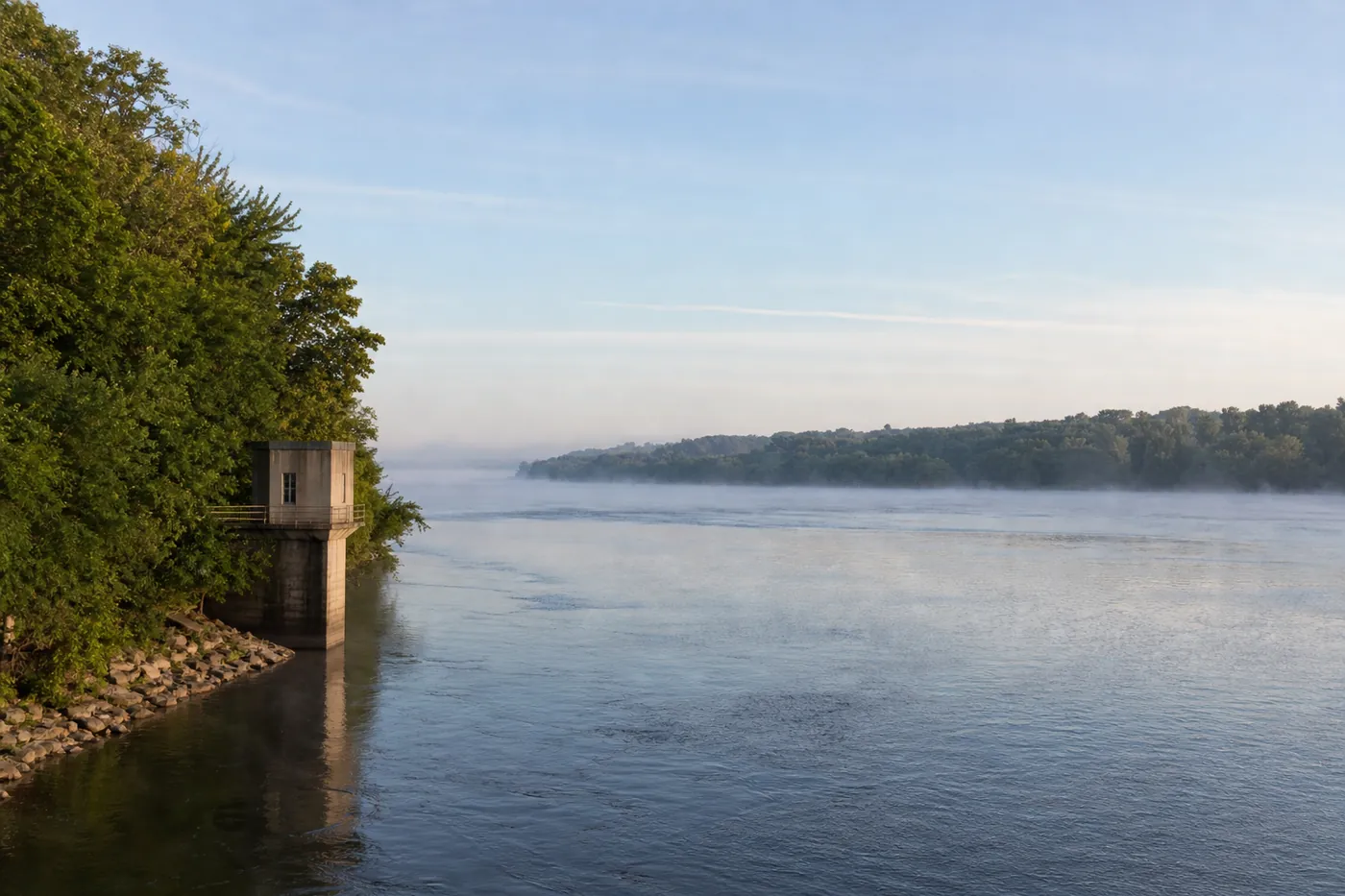
The Mississippi River (2025 Water Quality Report). Minneapolis treats it at two plants, in Fridley and Columbia Heights, and delivers an average of 57 million gallons a day. The Fridley plant filters through granular activated carbon and the Columbia Heights plant through ultrafiltration membranes; both share a softening step that removes about 65,000 pounds of hardness daily (City of Minneapolis).
Reading the 2025 mineral record
- Total hardness: 80 to 113 mg/L, average 94. Divide by 17.1 for grains per gallon.
- Calcium and magnesium: 30 ppm and 3.8 ppm on average, the minerals that form scale.
- Sodium: 18.6 ppm on average before any home softener adds more; the 2025 report notes that sodium shifts with river conditions.
- pH: 9.06 on average, on the alkaline side.
- Iron and manganese: 0.01 ppm and below detection, so iron fouling is a well problem here, not a city one.
- Chloride: 33.1 ppm on average.
Those numbers sit under the 7-grain, 120 mg/L level above which the Minnesota Department of Health says a softener may be needed.
Who else drinks this water?
About 22% of Minneapolis water goes to seven suburban cities: Bloomington, Columbia Heights, Crystal, Edina (the Morningside area), Golden Valley, Hilltop and New Hope (City of Minneapolis). Homes there on the city's supply see similar hardness. Elsewhere it depends on the local system. Robbinsdale, for instance, ran on 24-grain groundwater until its new plant began softening to about 5 grains in late 2022 (Minnesota Department of Health), and the department says most neighboring communities soften centrally.
What to do with the number
Set any existing softener close to it; see repair, reset or remove. If you are on a private well, none of this applies; have the well tested by an accredited lab, which MDH lists through its Environmental Laboratory Accreditation Program. Price ranges for every option are in the Minneapolis water softener cost guide.
Sources
- Minneapolis Water Treatment & Distribution Services: Plant Effluent Water Analysis, 2025
- Minneapolis Water Works: Monthly Plant Effluent Water Analysis, September 2026
- U.S. Geological Survey Water Science School: Hardness of Water
- Minnesota Department of Health Waterline: Robbinsdale's new softening plant
What is your water doing?
A sentence is plenty: a softener that runs out of salt too fast, spots that will not go away, a private well, a taste you do not like. One independent water treatment specialist who works in Minneapolis will get in touch.